

Have you ever worried about a friend, colleague, or family member but weren’t sure how to ask if they’re really okay? We’ve all had that feeling. Maybe they’re a little quieter than usual, seem distracted, or just seem a bit off. That feeling is your cue to act.
You’re not alone. Research shows that 1 in 5 Australians experience mental illness each year. [1] Yet many people suffer in silence without seeking help. [1] That’s why initiatives like R U OK? Day are so important. They remind us that a simple, genuine conversation can make a world of difference.
R U OK? Day is on the second Thursday of September every year. But it isn’t just about one day. It’s about building the skills to have meaningful conversations throughout the year. [2] Research shows the R U OK? Conversation steps are highly effective, with 86% of people who used them finding them helpful. [3] You don’t need to be a mental health expert to make a difference. You just have to be a good friend and a great listener. A simple, genuine conversation can help someone who might be struggling in silence. Mental health is complex, but the first step to helping is often as simple as asking, “Are you okay?”

Here are some easy-to-follow steps to help you start that important conversation. (Based on the framework from R U OK?)
Getting ready to ask
Before you dive in, take a moment to prepare. This conversation isn’t about solving someone’s problems. It’s about showing you care and creating a safe space for them to talk.
- Ask yourself: Am I in a good headspace to genuinely listen?
- Ask yourself: Can I handle whatever they might share? Prepare yourself mentally not to take on their emotional burden as your own.
- Ask yourself: Have I found the right place and time? Look for a private, comfortable setting where you won’t be interrupted.
- Ask yourself: Have I let go of my expectations? They might not be ready to talk, and that’s okay. They might also prefer to talk to someone else. Respect their choice and let them know you’re always there if they change their mind.
- Ask yourself: Do I have enough time? Rushing this conversation can do more harm than good.
The four steps of a conversation
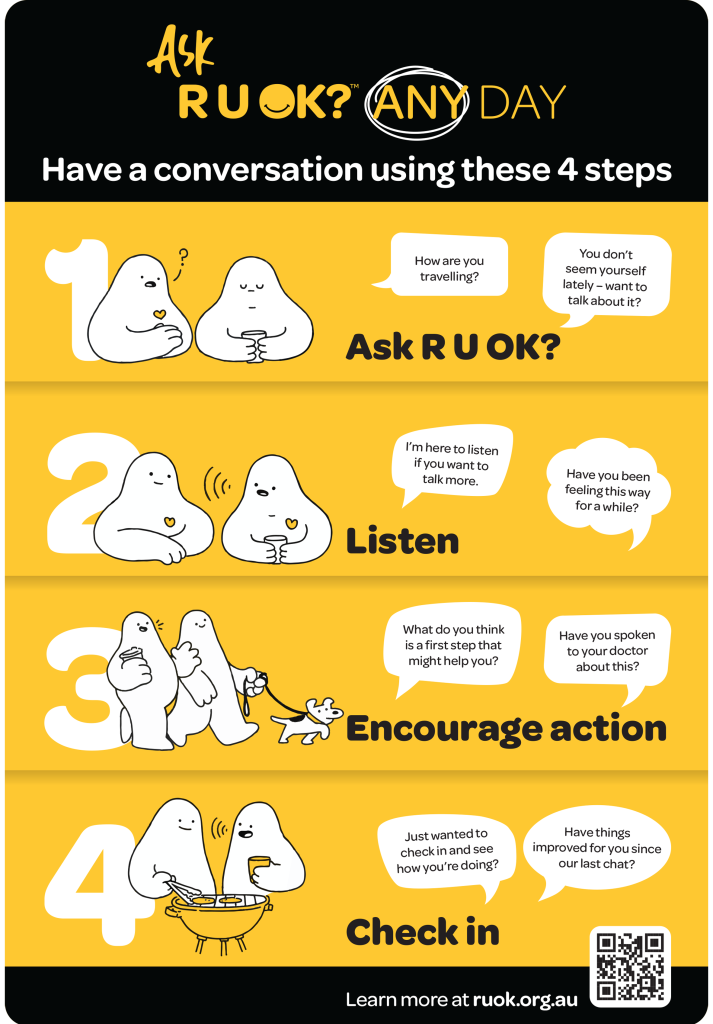
The R U OK? organisation provides a simple and effective four-step process for these conversations.
Step 1: Ask R U OK?
Approach the conversation with concern. Be relaxed, friendly, and genuine. You could say something like:
- “Hey, you’ve seemed a bit quiet lately. Is everything okay?”
- “I’ve noticed you’ve been a little stressed. How are you doing?”
- “Just wanted to check in. R U OK?”
If they don’t want to talk, don’t criticise them. Instead, you could say, “Let me know if you ever want to chat”.
Step 2: Listen without judgement
This is the most crucial part. They might not have all the answers, and that’s perfectly fine. Your job is to listen openly and without interruption.
- Ask open-ended questions that encourage a longer answer. Instead of “Did you have a good day?” try, “How has your week been?”
- If they need time to think, sit in the silence with them. It can feel uncomfortable, but it shows you’re taking them seriously.
- If you’re unsure about what they mean, repeat back what you’ve heard in your own words. For example, “It sounds like you’re feeling a bit overwhelmed. Is that right?”
Step 3: Encourage action
If they’ve shared that they’re not okay, you can empower them to take the next step.
- Ask them what they’ve done in the past to manage similar situations.
- Offer your support: “What can I do to support you?” or “I’m here for you, no matter what.”
- If they’ve been feeling down for two weeks or more, gently suggest they seek professional help. You can say, “It might be helpful to chat with a professional. I can help you look up some options if you’d like.”
Step 4: Check-in
Your support doesn’t end after one conversation. The follow-up is vital.
- Set a reminder to check in with them in a few weeks. A simple text or call can make a world of difference.
- Don’t judge if they haven’t found a solution. Just ask how they’re going and if there’s anything else you can do to help.
- Make it easy for them to reach out: “If you need to talk before then, call me anytime—even if it’s 2 AM.”
- Be consistent: Follow through on your promises. Unreliability can reinforce feelings of abandonment.

When to take the next step
Sometimes, a conversation isn’t enough. If you are concerned about someone’s immediate safety, encourage them to seek professional help immediately. The following resources are available 24/7.
- Lifeline: 13 11 14
- Suicide Call Back Service: 1300 659 467
- Beyond Blue: 1300 22 4636
- Kids Helpline (5-25 years): 1800 55 1800
- MensLine Australia: 1300 78 99 78
- Q-life LGBTQIA+: 1800 184 527
- Lifeline Text (6pm-12am): 0477 131 114
- GriefLine: 1300 845 745
- 13YARN: 13 92 76
If you believe their life is in immediate danger, please call 000.
Keep the conversation going
R U OK? Day is just the beginning. The skills you develop can be used throughout the year to strengthen relationships.
Let’s commit to reaching out and checking in with each other. A simple question can save a life. You already have the most important qualification for this conversation: you care about someone. That’s enough to start. Trust that your willingness to ask and listen can make a profound difference. And remember: perfect conversations don’t save lives, genuine ones do.
This R U OK? Day, choose one person to check in with. Send them a message, invite them for coffee, or simply ask, ‘How are you really going?’. That one question could change everything.